READ AND SAVE THESE INSTRUCTIONS
INSTALLATION, OPERATING INSTRUCTIONS & PARTS MANUAL
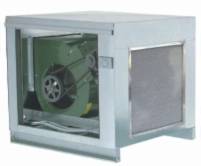
Filtered Make-Up Air Fan
Belt Driven for Roof Mounting

Electrical wiring and connections should be done in accordance with local ordnances and the National Electric Code, NFPA70. Be sure the voltage and phase of the power supply and the wire amperage capacity is in accordance with the motor nameplate. For additional safety information refer to AMCA publication 410-96, Recommended Safety Practices for Users and Installers of Industrial and Commercial Fans.
   RECEIVING AND INSPECTION   
Upon receiving unit, check for any damage and report it immediately to the carrier. Also check that all accessory items are accounted for.


   GENERAL SAFETY INFORMATION   
Installation of this ventilator should only be performed by a qualified professional who has read and understands these instructions and is familiar with proper safety precautions. Improper installation poses serious risk of injury due to electric shock, contact with rotating equipment and other potential hazards. Special considerations resulting from high winds or seismic activity may be required. Consult with a licensed professional engineer for more information if necessary.
  1. Wheel must be free to rotate and should not strike or rub any stationary object.
  2. Follow all local electrical and safety codes, as well as the National Electrical Code (NEC), the Occupational Safety and Health Act (OSHA), and the National Fire Protection Association (NFPA), where applicable.
  3. Motor must be securely and adequately grounded.
  4. Fan Wheel should not run at speeds higher than specified for motor furnished (see product catalog) with the ventilator at any given HP. Adjustments to fan speed significantly effect motor load. If the fan RPM is changed, the motor current should be checked to be sure it is not exceeding the motor nameplate amps.
  5. Always disconnect power before working on or near a fan. Lock and tag the disconnect switch or breaker to prevent accidental power up.
  6. Caution-when servicing fan, motors may be hot enough to cause pain or injury. Allow Motor to cool before servicing.
  7. Secure the power cable to prevent contact with sharp objects.
  8. Do not kink power cable and never allow the cable to come in contact with oil, grease, hot surfaces or chemicals.
  9. Make certain that the power source is compatible with the requirements of your equipment.

   INSTALLATION   
WARNING: DISCONNECT POWER BEFORE INSTALLING OR SERVICING.
Caution: Do not raise ventilator by the impeller, motor or bearings – use lifting lugs provided or a sling or platform.

   OPERATION   
  1. Before starting up or operating the ventilator, check all fasteners for tightness. In particular, check the set screw in the wheel hub, bearings and the fan sheaves (pulleys). With power to the fan OFF or prior to connecting ventilator to power, turn the fan wheel by hand to be sure it is not striking the inlet or any obstacles. Re-center if necessary.
  2. Start the fan up and shut it off immediately to check rotation of the wheel with the directional arrow on the blower scroll. Reversed rotation will result in poor air performance, motor overloading and possible burnout. For units equipped with a single-phase motor check the motor wiring diagram to change rotation.
  3. When the fan is started up, observe the operation and check for any unusual noises.
  4. Measure fan speed with a reliable tachometer. Motor sheave (pulley) is variable pitch, and allows for adjustment down from the RPM shown in the catalog. Excessive speed will result in motor overloading.
  5. With the air system in full operation and all ducts attached, measure the current input to the motor and compare with the motor nameplate to determine if the motor is operating under safe load condition.
  6. Once the rpm of the ventilator has been properly set, disconnect power and recheck belt tension and pulley alignment as described below.
Keep inlets and approaches to the ventilator clean and free from obstruction.

   MOTOR PULLEY ADJUSTMENT   
The adjustable motor pulley is factory set for the RPM specified. Speed can be increased by closing or decreased by opening the adjustable motor sheave. Two groove variable pitch pulleys must be adjusted an equal number of turns open or closed. Any increase in speed represents a substantial increase in horsepower required by the unit. Motor amperage should always be checked to avoid serious damage to the motor when the speed is varied.

   PULLEY ALIGNMENT   
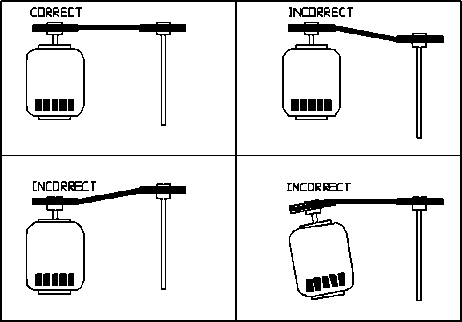
Pulley alignment is adjusted by loosening the motor pulley or driven pulley set screws and moving the pulley on the shaft. See Fig. 2. A straight edge should be used when aligning pulleys.
Fig. 2

   BELT TENSION   
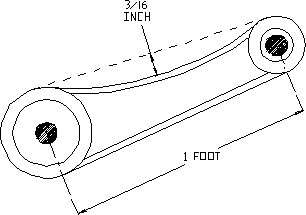
Belt tension should be checked after the first 48 hours of fan operation. Do not tension belts by changing the setting of the motor pulley, this will change the fan speed and may damage the motor. To re-tension belts, with the power to the fan motor OFF. Loosen the fasteners that hold the motor to the motor mounting plate. Slide the motor to the left or right to adjust the belt tension. Belt tension should be adjusted to allow 1/64” of deflection per inch of belt span. See Fig. 3. Exercise extreme care when adjusting V-belts as not to misalign pulleys. Any misalignment will cause a sharp reduction in belt life and produce squeaky noises. Overtightening will cause excessive belt and bearing wear as well as noise. Too little tension will cause slippage at startup and uneven wear. Whenever belts are removed or installed, never force belts over pulleys without loosening motor first to relieve belt tension.
Fig. 3

   MAINTENANCE   
WARNING: DO NOT ATTEMPT MAINTENANCE ON THE FAN UNTIL THE ELECTRICAL SUPPLY HAS BEEN COMPLETELY DISCONNECTED.
  1. Fan inlet and approaches to ventilator should be kept clean and free from any obstruction.
  2. Motors are normally permanently lubricated. Check bearings periodically, if they have grease fittings lubricate each season. Use caution when lubricating bearings, wipe the fittings clean, the unit should be rotated by hand while lubricating. Caution: Use care when touching the exterior of an operating motor. Motors normally run hot and may be hot enough to be painful or cause injury.
  3. Belt tension should be checked after two days of fan operation and each season thereafter. See instructions elsewhere in this manual. Over-tightening will cause excessive bearing wear and noise. Too little tension will cause slippage at startup and uneven wear.
  4. Blowers require very little attention when moving clean air. Occasionally oil and dust may accumulate causing imbalance. If the fan is installed in a corrosive or dirty atmosphere, periodically inspect and clean the wheel, inlet and other moving parts to ensure smooth and safe operation.
  5. All fasteners should be checked for tightness each time maintenance checks are preformed prior to restarting unit.
  6. Filters need to be cleaned and washed semi annually, more often in severe conditions.

   TROUBLESHOOTING CHART   
Problems and Potential Cause

Fan Inoperative
  • Open circuit breaker or overload in starter set too low. Reset circuit breaker or check setting of overload.
  • Motor wired incorrectly. Check motor wiring to wiring diagram located on fan motor.
Insufficient Air or Pressure
  • Fan rotating in the wrong direction. Be sure fan is rotating in the direction shown on rotation label.
  • Poor inlet conditions. There should be a straight clear duct at the inlet.
  • Be sure duct access doors are closed and dampers are operating properly.
Excessive Vibration and Noise
  • Belts too loose, worn or oily. Inspect and replace if needed.
  • Misaligned pulleys. Refer to “Pulley Alignment” section.
  • Fan speed is too high. Refer to “Motor Pulley Adjustment” section.
  • Fan rotating in the wrong direction. Be sure fan is rotating in the direction shown on rotation label.
  • Bearings need lubrication or replacement.
  • Damaged or unbalanced wheel.
  • Fan is operating in the unstable region of the fan curve.
Motor Overload
  • Fan rotating in the wrong direction. Be sure fan is rotating in the direction shown on rotation label.
  • Fan speed is too high. Refer to “Motor Pulley Adjustment”.
  • Motor wired incorrectly. Check motor wiring to wiring diagram located on fan motor.
  • Overload in starter set too low.

Warranty

This equipment is warranted to be free from defects in materials and workmanship, under normal use and service, for a period of 24 months from date of shipment. This warranty shall not apply if:

  1. The equipment is not installed by a qualified installer per the MANUFACTURER'S installation instructions shipped with the product,
  2. The equipment is not installed in accordance with federal, state and local codes and regulations,
  3. The equipment is misused or neglected,
  4. The equipment is not operated within its published capacity,
  5. The invoice is not paid within the terms of the sales agreement.

The MANUFACTURER shall not be liable for incidental and consequential losses and damages potentially attributable to malfunctioning equipment. Should any part of the equipment prove to be defective in material or workmanship within the 24-month warranty period, upon examination by the MANUFACTURER, such part will be repaired or replaced by MANUFACTURER at no charge. The BUYER shall pay all labor costs incurred in connection with such repair or replacement. Equipment shall not be returned without MANUFACTURER'S prior authorization and all returned equipment shall be shipped by the BUYER, freight prepaid to a destination determined by the MANUFACTURER.